Fort DeSoto Park · Tierra Verde, Pinellas County Fort DeSoto Spanish-American War CannonsOriginally from Egmont Key — 6-inch Armstrong Rifles purchased from England in 1898, now at Fort DeSoto Park ✦ ✦ ✦These massive 6-inch Rapid Fire Armstrong Rifles — each weighing 17 tons — were purchased from England in 1898 because the United States could not yet manufacture rapid-fire coastal defense weapons of this type. Installed at Fort Dade on Egmont Key on December 10, 1898, they guarded the mouth of Tampa Bay for over two decades before being recovered and restored to Fort DeSoto Park in 1982. 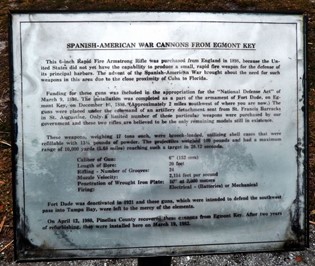
Spanish-American War Cannons — originally from Fort Dade, Egmont Key · Now at Fort DeSoto Park, Tierra Verde, FL
The 6-Inch Armstrong RiflesWhen the United States entered the Spanish-American War in April 1898, the Army urgently needed rapid-fire coastal defense weapons to protect Tampa Bay — the nation's primary embarkation point for the Cuba invasion force. The problem was that American industry at the time could not produce a small, rapid-fire weapon of sufficient power for harbor defense. The solution was to purchase from abroad. The 6-inch Rapid Fire Armstrong Rifle — manufactured by the renowned British armaments firm Armstrong Whitworth — was the answer. Two were purchased and installed at Fort Dade on Egmont Key, completing the armament of that coastal defense installation on December 10, 1898, months after the war had already ended with Spain's surrender. Technical Specifications6-Inch Rapid Fire Armstrong Rifle — 1898
Manufacturer
Armstrong Whitworth, England
Purchased
1898 — U.S. lacked domestic production capability
Caliber
6 inches
Weight
17 tons each
Loading system
Breech-loading with refillable shell cases
Propellant charge
13½ pounds of powder
Projectile weight
100 pounds
Maximum range
10,000 yards (5.68 miles)
Time to target at max range
28.12 seconds
Original installation
Fort Dade, Egmont Key — December 10, 1898
From Egmont Key to Fort DeSoto⚙️
1898 — December 10
Installed at Fort Dade, Egmont KeyThe two Armstrong Rifles are installed on Egmont Key at the mouth of Tampa Bay, completing the armament of Fort Dade — the coastal defense installation designed to protect Tampa Bay from Spanish naval attack. The war was already over, but the fort was garrisoned and the guns stood ready. 🔒
1921
Fort Dade DeactivatedFollowing World War I, Fort Dade on Egmont Key is deactivated by the U.S. Army. The cannons remain on the island, unmanned and largely forgotten, for nearly six decades. 🚢
April 12, 1980
Recovered from Egmont KeyPinellas County recovers the cannons from Egmont Key — a significant logistical undertaking given each weapon weighs 17 tons. They are transported to the mainland for restoration. 🔧
1980–1982
Two Years of RefurbishingAfter more than 80 years on Egmont Key — 60 of them abandoned — the cannons undergo two years of careful restoration work to preserve their historical integrity. 🏛️
March 19, 1982
Installed at Fort DeSoto ParkThe fully refurbished cannons are installed at their permanent home in Fort DeSoto Park — just a short distance from Battery Laidley, the original 1898 gun emplacements — where visitors can see them today. Marker DescriptionSpanish-American War Cannons — Originally from Egmont KeyThe 6-inch Rapid Fire Armstrong Rifle was purchased from England in 1898, because the United States did not have the capability to produce a small, rapid-fire weapon for the defense of its principal harbors. The advent of the Spanish-American War brought about the need for such weapons in this area due to the close proximity of Cuba to Florida. The installation was completed as a part of the armament of Fort Dade, on Egmont Key, on December 10, 1898. These weapons, weighing 17 tons each, were breech-loading, utilizing shell cases that were refillable with 13½ pounds of powder. The projectile weighed 100 pounds and had a maximum range of 10,000 yards (5.68 miles), reaching its target in 28.12 seconds. Fort Dade was deactivated in 1921. On April 12, 1980, Pinellas County recovered the cannons from Egmont Key. After two years of refurbishing, they were installed at Fort DeSoto Park on March 19, 1982. All Three Fort DeSoto LandmarksFort DeSoto Park — Spanish-American War Sites
🚩
Spanish-American War Memorial & Flag Pole — The 1963 dedication marker honoring American Patriots of 1898, especially the Rough Riders.
🏰
Fort DeSoto Batteries & Military Post — The Endicott-era concrete gun batteries and 29-building military post built in 1898.
💣
Fort DeSoto Spanish-American War Cannons — You are here. The 6-inch Armstrong Rifles, recovered from Egmont Key and restored in 1982.
LocationFort DeSoto Park — Tierra Verde, FL 33715
Coordinates: 27° 36.933′ N, 82° 44.140′ W |